/* AAA:hide-author */.byline,.post-author,.entry-author,.author-name,.entry-meta .author,.post-meta .author,[rel=”author”],.ast-single-post .entry-meta .posted-by,.ast-single-post .ast-author-meta,.ast-single-post .entry-meta .avatar,.ast-author-name{display:none!important}
Pietra Grey Marble: How to Achieve the Perfect Polished Finish Without Scratches
Last reviewed: June 11, 2026
Methodology: This commercial investigation evaluates Pietra Grey Marble by weighting finish quality and scratch risk at 35%, slab selection and visual consistency at 25%, compliance and test documentation at 20%, landed cost transparency at 10%, and supplier service capability at 10%. The recommendations below follow that weighting: a cheaper slab is not ranked above a cleaner, better-documented slab when the project requires a high-gloss polished finish.
Limitations note: Public B2B prices, supplier listings, and market reports change quickly and may not include freight, duties, wastage, fabrication, or local installation. Buyers should verify live quotations, quarry origin documents, test reports, finish samples, and batch photos before issuing a purchase order.
What is Pietra Grey Marble and why does the polished finish scratch so easily?
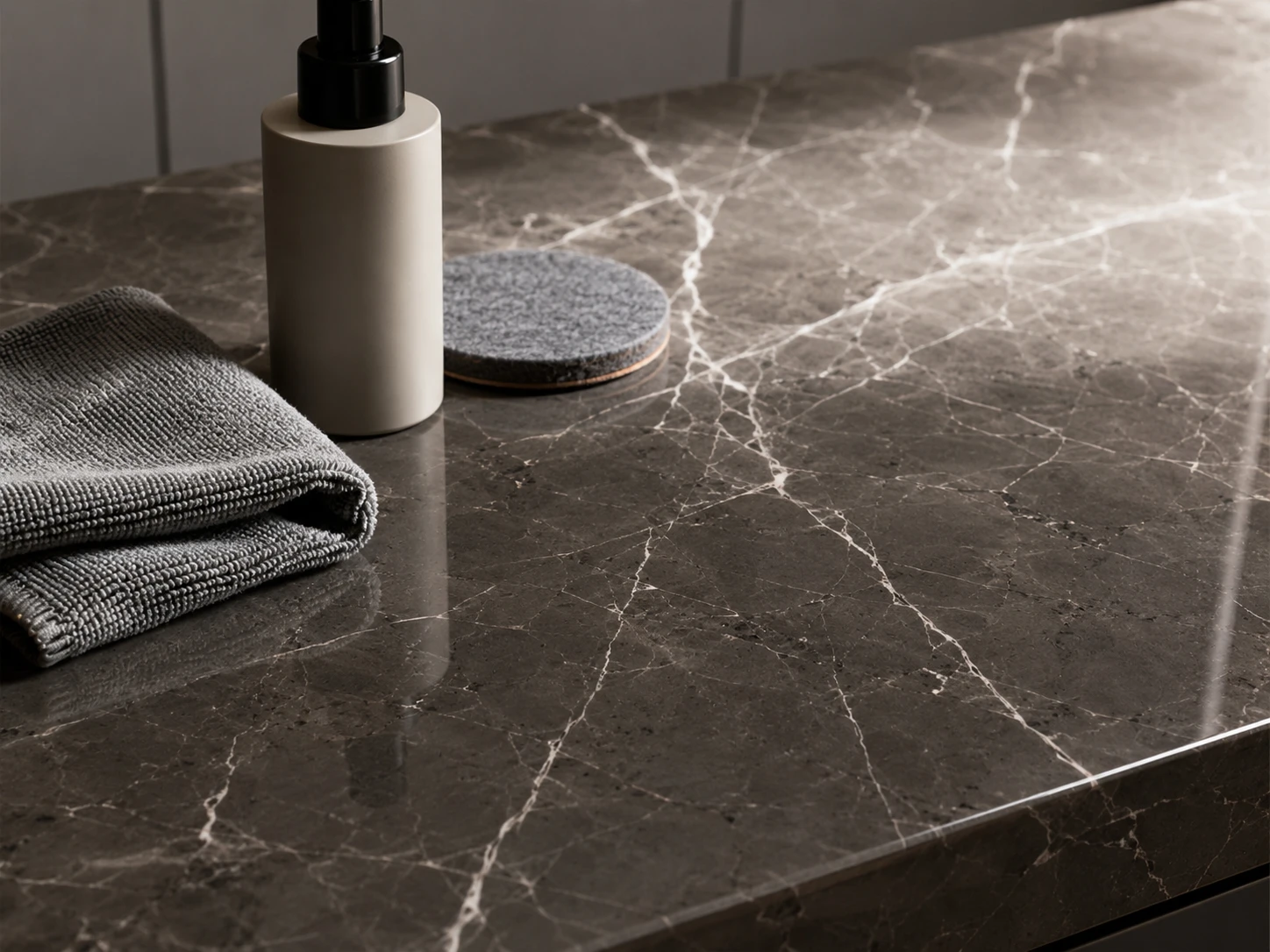
Pietra Grey Marble is a fine-grained dark grey marble with white calcite veining, valued because polishing creates a mirror-like contrast between the charcoal field and bright linear veins. Its vulnerability is not a defect; it comes from marble’s calcite-rich mineralogy, which is softer than quartz, porcelain, and many common abrasives tracked onto floors or dragged across countertops.
In practical procurement language, Pietra Grey is bought for visual drama: dark background, controlled white veining, and a dense polished look that suits hotel vanities, luxury residential kitchens, elevator portals, lobby feature walls, and retail counters. Buyers usually search for polished Pietra Grey Marble slabs, Pietra Grey Marble countertop supplier, or how to prevent scratches on Pietra Grey Marble because the material is attractive but unforgiving when finished poorly.
The most important technical fact is hardness. Marble is composed largely of calcite or dolomite minerals; calcite is commonly listed at Mohs hardness 3 by geology references, while quartz is Mohs 7. That difference explains why sand, construction dust, unglazed ceramic bases, and metal grit can mark a polished marble surface even when the slab itself is structurally sound.
A perfect polished finish is therefore a controlled system, not a single factory step. The system includes proper block selection, resin filling where appropriate, calibrated grinding, progressive abrasive polishing, clean water management, final buffing, safe packaging, and protected handling after delivery. A supplier can deliver a glossy slab, but scratches often appear later from forklift arms, dirty A-frame pads, steel strapping, careless dry wiping, or installation teams cutting other materials nearby.
- Polished finish
- A high-gloss mechanical finish produced by progressively finer abrasives and final buffing; it maximizes depth of color and veining contrast but shows scratches, etching, and fingerprints more readily than honed stone.
- Honed finish
- A smooth matte or satin finish that reduces glare and makes fine abrasion less visible; it is often more forgiving for floors, stairs, and high-touch hospitality surfaces.
- Etching
- A chemical dull mark caused when acids react with calcite in marble; it is different from a scratch and cannot be solved only with a topical sealer.
- Raking light inspection
- An inspection method using low-angle light across the stone surface to reveal swirl marks, sanding lines, resin drag, and shallow scratches that overhead light may hide.
How should buyers specify a scratch-resistant polished Pietra Grey Marble finish?
Buyers should specify the finish as a measurable acceptance standard, not simply write “polished” on the order. The purchase specification should define face selection, slab thickness, polishing sequence, acceptable repair visibility, protection film requirements, packaging method, and inspection conditions under both overhead and raking light.
Start with the application. For wall panels, fireplace surrounds, reception desks, and low-abuse vanity backsplashes, a high-gloss polish usually makes commercial sense because the stone is seen more than touched. For kitchen worktops, bar counters, shop counters, and hotel bathrooms, polished Pietra Grey can still work, but the buyer must accept that acids and abrasives require disciplined care.
A commercial specification should request current slab photos from the same bundle, not only brochure images. Dark marble can vary by quarry bench and block; white veining may be fine, cloudy, broken, or strongly linear. If book-matching is required, ask for slab sequence numbers, full-slab dry layout images, and vein alignment approval before cutting.
For finish quality, the most useful practical test is visual consistency. Ask the supplier to photograph the polished face under low-angle light before packing. Swirl marks, cloudy areas, drag marks, and patchy resin sheen are easier to fix at the factory than after the slab has reached the jobsite. If you are buying through forustone or another exporter, require written agreement on what counts as an unacceptable polishing defect before production begins.
Thickness should match the end use. Interior wall cladding may use thinner cut-to-size panels when properly backed and fixed, while countertops and islands commonly use thicker slabs or laminated edges. Thickness tolerance, edge treatment, and reinforcement details matter because reworking a dark polished edge on site can create visible shade and gloss differences.
Key Takeaways
- Pietra Grey Marble polishes beautifully because its dark grey field and white veining create strong visual contrast, but the polished surface shows abrasion quickly.
- Calcite-based marble is softer than quartz-rich grit, so construction dust control is a real scratch-prevention requirement, not a cosmetic preference.
- For commercial buying, the best specification defines inspection light, finish acceptance, slab sequence, packaging, and protection before payment milestones.
- Choose polished Pietra Grey for vertical or moderate-use premium surfaces; choose honed finish for floors, stairs, and high-touch areas where micro-scratches are expected.
- Request ASTM C503/C503M-style physical test data, water absorption results, and supplier batch photos rather than relying only on trade grade names.
- Budget decisions should compare slab price, wastage, polishing rework risk, freight, duties, and installation protection, not only the FOB square-meter quote.
Polished or honed: which Pietra Grey Marble finish should you choose?
Choose polished Pietra Grey Marble when the project needs depth, reflection, and luxury contrast; choose honed Pietra Grey when the surface will face frequent foot traffic, sliding objects, or aggressive cleaning. A polished finish is more dramatic, but a honed finish hides wear better and is often safer for busy floors.
| Decision factor | Polished Pietra Grey Marble | Honed Pietra Grey Marble | Buyer verdict |
|---|---|---|---|
| Visual impact | Highest contrast, deeper charcoal tone, strong reflection, premium showroom look. | Softer grey appearance, less reflection, more architectural and understated. | Best for: polished finish when design value depends on dramatic veining and light reflection. |
| Scratch visibility | Fine scratches and swirl marks appear more easily under raking light. | Minor abrasion blends into the matte surface more naturally. | Best for: honed finish when cleaning teams or end users may drag objects across the stone. |
| Etch visibility | Acid etching creates dull spots that contrast strongly with gloss. | Etching is still possible but usually less visually abrupt. | Best for: honed finish for bars, bathrooms, and food-preparation surfaces exposed to acids. |
| Commercial maintenance | Requires strict microfiber cleaning, entrance mats, felt pads, and periodic professional refinishing. | More forgiving for routine maintenance and touch-up blending. | Best for: polished finish only where maintenance standards are controlled. |
| Typical applications | Feature walls, reception desks, vanity tops, fireplace surrounds, luxury retail counters. | Floors, stairs, hospitality bathrooms, restaurant counters, high-touch public interiors. | Bottom line: match finish to abrasion risk before choosing purely by sample-room appearance. |
How to use this table: prioritize the scratch visibility and maintenance columns for public projects, the visual impact column for luxury residential or retail projects, and choose the lower-risk finish when two options look equally attractive in the sample room.
The polished-versus-honed decision is also a commercial risk decision. A developer may love the polished sample, but the owner’s cleaning contractor may use abrasive pads or acidic cleaners after handover. In that situation, the buyer should either choose honed stone or include written maintenance instructions, approved cleaner lists, and post-installation protection responsibilities in the contract.
Bottom line: polished Pietra Grey is best for controlled, high-visibility surfaces where the owner values depth and contrast enough to maintain the finish correctly.
What grades, slab parameters, and inspection points matter for commercial procurement?
Commercial buyers should treat Pietra Grey grade as a negotiated bundle of visual quality, structural soundness, finish consistency, and documentation. Grade labels such as A, premium, commercial, or first choice are not standardized across all suppliers, so they must be translated into objective acceptance criteria.
Start with the slab face. A high-value bundle should show a consistent dark grey background, attractive white veining, limited open fissures, acceptable resin work, and no obvious polishing cloudiness. Some veining variation is part of natural stone, but random cracks, weak corners, heavy filler, or mismatched book-match pairs can increase fabrication loss.
Next, inspect thickness, flatness, and edge integrity. Dark marble with a polished face can show lippage and uneven reflection clearly when installed under linear LED lighting. Ask for calibrated thickness tolerances, especially for cut-to-size wall panels, and request corner protection for long-distance shipping.
Physical testing matters because ASTM C503/C503M covers marble dimension stone classification and test requirements, while ASTM C1528 is a guide for selecting dimension stone for building use. These standards do not replace project engineering, but they give buyers a common vocabulary for absorption, density, strength, abrasion resistance, and suitability.
| Inspection item | What to request | Why it matters | Per-item verdict |
|---|---|---|---|
| Bundle photos | Full-slab images from the actual bundle, with slab numbers visible. | Prevents approval based on a better-looking reference slab from another block. | Best for: buyers ordering feature walls or book-matched panels. |
| Raking light video | Short video across the polished face before packing. | Reveals sanding lines, polishing haze, and handling scratches. | Best for: high-gloss countertop and reception-desk orders. |
| Test documentation | Absorption, density, strength, and abrasion test reports where available. | Supports engineering review and reduces disputes over suitability. | Best for: commercial projects with architects, consultants, or public tenders. |
| Packaging plan | Wooden bundles, foam separation, face protection, corner guards, and dry loading photos. | Many scratches happen after polishing, during handling and transport. | Best for: export buyers and distributors receiving mixed containers. |
| Sealer and care guide | Recommended penetrating sealer, curing time, cleaner type, and handover instructions. | Sealer can reduce staining risk but does not make marble scratch-proof or acid-proof. | Bottom line: documentation protects both the buyer and the supplier from unrealistic expectations. |
How to use this table: use the “what to request” column as your purchase-order attachment, use the “why it matters” column to explain requirements to suppliers, and give priority to raking light video when polished finish quality is the main risk.
How much should buyers budget for Pietra Grey Marble slabs and polished finishing?
Buyers should budget Pietra Grey Marble by total landed and installed cost, not by slab price alone. Public B2B listings commonly show broad FOB ranges for dark grey marble slabs and tiles, but the final project cost can change materially after thickness, finish, wastage, freight, duties, cutting, edge polishing, sealing, and protection are included.
As a planning range, public supplier platforms such as Alibaba and Made-in-China often display dark grey or Pietra Grey marble slab and tile offers in roughly the mid-double-digit US dollar range per square meter, with wide variation by thickness, origin claim, finish, minimum order quantity, and order size. Treat those figures as quotation prompts, not verified contract prices.
For a real commercial purchase, ask for at least three price layers: raw slab or tile price, fabrication price, and logistics cost. A polished slab that looks cheaper at FOB level may become expensive if it has higher wastage, inconsistent veining, weak packaging, or requires repolishing after arrival.
Polishing cost is not just labor. It includes abrasive wear, water, resin, quality-control time, rework allowance, face protection film, and the risk of rejecting cloudy slabs. On dark marble, poor polishing is highly visible, so a reputable supplier should not promise luxury finish quality at the same cost as a basic commodity tile.
Market context also matters. Grand View Research and Fortune Business Insights both report continued global demand for natural stone and marble-related products, driven by residential renovation, hotels, commercial interiors, and premium architectural surfaces. That trend supports demand for visually distinctive stones such as Pietra Grey, but it also makes block consistency and supplier screening more important when large projects compete for attractive bundles.
Original cost analysis: what is the real cost of avoiding scratches?
The cheapest way to avoid scratches is usually prevention before installation, not repair after handover. The following model is a calculation estimate, not a market average. It uses explicit assumptions so buyers can replace the numbers with their own supplier quotations, freight costs, and local labor rates.
| Cost item | Assumption used | Estimated cost | Reasoning |
|---|---|---|---|
| Base polished stone supply | 100 m² at an assumed US$55/m² planning price | US$5,500 | Mid-range placeholder for sensitivity testing; buyer must replace with live quotation. |
| Extra quality-control documentation | Raking light videos, slab numbering, dry layout photos, packing photos | US$150–US$350 | Often negotiated into service, but complex orders may need additional inspection time. |
| Protective packaging upgrade | Foam sheets, corner guards, face protection, reinforced bundle handling | US$250–US$600 | Small compared with replacement cost if polished faces arrive scratched. |
| Installation protection | Temporary coverings, clean-zone control, microfiber-only cleaning, felt pads | US$300–US$800 | Prevents grit damage during the highest-risk construction phase. |
| Potential repolishing avoided | Assume 10 m² affected at US$35–US$75/m² local repair allowance | US$350–US$750 avoided | Local repair can be disruptive and may not perfectly match factory gloss. |
How to use this table: replace the assumed base price first, then adjust packaging and installation protection according to transport distance and jobsite risk; if the avoided repair line approaches the protection cost, prevention should be approved.
How this is calculated: total prevention cost equals added inspection plus packaging upgrade plus installation protection. In this model, that range is US$700–US$1,750, or about US$7–US$17.50 per m² on a 100 m² order. If the project includes high-value book-matching, hotel opening deadlines, or remote installation, the prevention premium becomes easier to justify.
Sensitivity note: if local repolishing labor is cheap and the project is small, the prevention premium may look high; if replacement slabs require air freight or delayed opening penalties, prevention is materially cheaper than repair.
Which sourcing route is best for a polished Pietra Grey Marble project?
Choose direct factory sourcing for custom cut-to-size work, distributor stock for urgent small orders, and project-based supply partners for hotels, villas, and commercial interiors requiring documentation. The right route depends on quantity, finish risk, schedule, and whether the buyer needs fabrication support.
| Situation | Recommended route | Why this route works | Verdict |
|---|---|---|---|
| Small urgent repair or local renovation | Buy from local distributor stock. | You can inspect the slab in person and avoid long import timelines. | Best for: buyers who need speed more than custom bundle selection. |
| Luxury residence with book-matched walls | Use a factory or exporter that can provide slab sequencing and dry layout. | Vein alignment, polishing consistency, and cutting accuracy are more important than lowest price. | Best for: owners and designers seeking visual continuity. |
| Hotel bathroom or vanity program | Use a project stone supplier with cut-to-size production and packing controls. | Repeated units need consistent finish, labeling, edge work, and damage-free logistics. | Best for: contractors who need predictable installation packages. |
| Commercial floor in heavy traffic | Reconsider polished Pietra Grey; specify honed finish or another harder surface. | Scratch visibility and slip maintenance risk may outweigh the decorative value. | Bottom line: do not force polished marble into an abrasion-heavy floor specification. |
| Distributor container purchase | Buy bundled slabs with documented photos, thickness, finish, and packaging before loading. | Inspection records reduce disputes when slabs are resold or fabricated later. | Best for: stone importers building reliable inventory. |
How to use this table: match your buying situation to the first column, then use the recommended route as the default; when two routes look close, choose the one that gives better inspection control for polished finish quality.
Forustone can be considered in the project-based category when the buyer needs export coordination, finish discussion, and slab-by-slab communication. The commercial advantage is not simply being a supplier; it is reducing ambiguity before cutting, packing, and shipment.
What regulations and standards should buyers check before approving Pietra Grey Marble?
Buyers should check stone standards, workplace silica rules, slip-resistance expectations, sustainability documentation, and project-specific building codes before approving polished Pietra Grey Marble. Standards do not guarantee beauty, but they reduce technical uncertainty and provide a shared basis for acceptance.
ASTM C503/C503M is the main marble dimension stone specification commonly referenced in North American stone procurement. It helps buyers request physical properties such as absorption, density, compressive strength, modulus of rupture, and abrasion resistance. ASTM C1528 supports material selection by encouraging proper evaluation of stone characteristics and application conditions.
Silica regulation matters during fabrication and installation. OSHA’s respirable crystalline silica standard for construction requires exposure controls when cutting, grinding, or polishing materials containing crystalline silica. Marble generally contains less quartz than engineered stone or granite, but dry cutting stone remains a serious occupational exposure issue, so wet methods, ventilation, respirators, and compliant work practices should be required.
Slip resistance is another practical compliance concern. Polished marble can be slippery when wet, especially on bathroom floors, lobbies, stairs, and spa areas. Buyers should ask the project architect or local code consultant which slip-resistance test method applies, then avoid polished marble in wet pedestrian zones unless the design and maintenance plan support safe use.
Sustainability requirements are becoming more common in commercial tenders. ANSI/NSC 373 provides a sustainability standard for natural dimension stone production, while green building projects may request environmental documentation, chain-of-custody information, or supplier declarations. These documents are not always mandatory, but they can influence hotel, corporate, and public-sector procurement decisions.
- Request ASTM-style physical property reports for commercial and exterior-adjacent applications.
- Require wet cutting, dust control, and safety procedures for fabrication and onsite modification.
- Confirm slip-resistance requirements before specifying polished marble on floors.
- Ask whether sustainability declarations are required by the architect, owner, or tender package.
- Keep approved samples, photos, test reports, and maintenance instructions in the project file.
Real-world case studies: where does polished Pietra Grey Marble perform well?
Polished Pietra Grey performs best where visual impact is high and abrasion is controlled. The strongest use cases are vertical cladding, vanities, reception desks, and premium residential surfaces with clear maintenance rules; the weakest use cases are gritty entrances, wet stairs, and uncontrolled public floors.
Case study 1: boutique hotel bathroom vanities
A boutique hotel using polished Pietra Grey for 80 vanity tops can benefit from the stone’s dark, luxurious tone because guests see the surface close-up under warm lighting. The procurement risk is not the marble itself but repeated exposure to cosmetics, acidic cleaners, luggage hardware, and housekeeping routines.
The best specification is polished tops with eased edges, sealed before installation, protected during fit-out, and handed over with neutral pH cleaning instructions. The buyer should also request spare pieces from the same block for future replacement. Best for: hospitality buyers who can control cleaning chemicals and want a premium bathroom identity.
Case study 2: residential kitchen island with waterfall sides
A luxury kitchen island with book-matched waterfall sides is a visually strong application because the vertical panels display the veining like furniture. The main risk is the horizontal cooking surface, where lemon juice, wine, grit, and ceramic dishes can dull or scratch the polish.
The practical solution is to use Pietra Grey where it is seen most and protect where it is used hardest. Some buyers specify marble for the island façade and a harder material for heavy preparation zones; others accept natural patina as part of ownership. Bottom line: polished Pietra Grey works in luxury kitchens when the owner accepts maintenance and uses cutting boards, trays, and felt pads.
Case study 3: corporate reception wall and desk
A corporate reception wall is one of the safest places to use polished Pietra Grey because the surface is vertical, highly visible, and rarely abraded. A matching reception desk creates continuity, but the desktop must be protected from laptops, metal bag feet, and delivery packages.
For this scenario, the buyer should request slab sequencing, dry layout approval, and raking light inspection of the desk top. If the desk receives heavy traffic, a honed working surface with polished vertical faces can balance maintenance and visual depth. Best for: commercial interiors that need a dark premium focal point without the scratch load of flooring.

What industry trends are shaping demand for Pietra Grey Marble?
Demand for Pietra Grey Marble is supported by the broader premium interiors trend toward dark, high-contrast natural materials. Designers continue to use grey, black, and white-veined stones because they photograph well, create strong focal points, and pair easily with metal, wood, glass, and neutral cabinetry.
Market research firms including Grand View Research and Fortune Business Insights report continued growth expectations for natural stone and marble-related markets through the late 2020s, driven by residential renovation, commercial construction, hospitality, and luxury interiors. These reports differ in exact category definitions, but they agree on the underlying direction: natural stone remains relevant where buyers want authenticity and unique patterning.
At the same time, buyers are becoming more technical. Large importers and contractors increasingly ask for slab videos, origin transparency, finish samples, test documentation, and packaging photos. This shift benefits suppliers that can manage evidence, not only attractive images.
Another trend is finish diversification. Polished stone remains popular for premium walls and vanities, but honed, leathered, brushed, and antique textures are gaining attention where glare, slip, and scratch visibility are concerns. For Pietra Grey, the best commercial strategy is to offer both polished and honed samples so the buyer can compare design impact against maintenance risk.
Finally, compliance pressure is rising. Silica exposure rules, green building documentation, and chain-of-custody expectations are no longer limited to public projects. Even private hospitality clients may ask suppliers to prove safer fabrication practices and reliable sourcing procedures before approving a stone package.
Practical asset: a buyer’s scratch-free polished Pietra Grey approval checklist
Use this checklist before deposit, before cutting, before shipment, and before installation. The order matters because scratches and finish disputes become more expensive after each step.
- Define the application first. Write whether the stone is for countertop, vanity, wall panel, reception desk, floor, stair, or fireplace. Ask the supplier which finish they recommend for that exact use and why.
- Ask for actual bundle photos. Request full-slab images, slab numbers, thickness, finish, and close-ups of veining, corners, resin areas, and any natural fissures.
- Confirm the finish standard. Ask for polished-face photos and a short raking light video. State that visible swirl marks, sanding lines, cloudy polish, and transport scratches must be approved or corrected before shipment.
- Request technical documents. Ask for available absorption, density, strength, and abrasion test information, especially for commercial projects or architect-reviewed jobs.
- Approve layout before cutting. For book-matched or vein-matched work, require a dry layout drawing or photo set showing each panel number and orientation.
- Specify edge details. Confirm eased, bevel, bullnose, miter, or laminated edge treatment. Ask whether edge polishing will match the face gloss and how corners will be protected.
- Control packaging. Require foam separation, face protection, corner guards, dry wooden crates or bundles, and loading photos. Ask how polished faces are prevented from rubbing during transport.
- Create a clean installation zone. Ban dry sweeping, abrasive pads, and cutting of gritty materials near installed marble. Use protective covering only after the stone is clean and dry.
- Hand over maintenance rules. Provide neutral pH cleaner instructions, felt-pad requirements, acid spill response, and a no-abrasive-cleaner policy to the owner or facility team.
- Keep evidence. Save approved photos, videos, test reports, packing images, delivery notes, and installation condition photos so any claim can be resolved factually.
FAQ
1. Is Pietra Grey Marble good for kitchen countertops?
Yes, Pietra Grey Marble can be used for kitchen countertops when the owner wants a luxury natural stone appearance and accepts marble maintenance. It is not as scratch-resistant or acid-resistant as quartzite, granite, porcelain, or engineered quartz. Use cutting boards, trays, felt pads, and neutral pH cleaners. If the kitchen is a heavy cooking workspace with citrus, wine, vinegar, and frequent ceramic dish movement, consider using Pietra Grey on the island sides or backsplash and a harder surface for the main prep zone.
2. How do you prevent scratches on polished Pietra Grey Marble?
Prevent scratches by controlling grit, friction, and handling. During procurement, require raking light inspection, face protection, foam separation, and corner guards. During installation, keep the area clean, avoid dry sweeping, and do not cut tile, metal, or cement board near exposed marble. After handover, use microfiber cloths, neutral pH cleaner, entrance mats, coasters, trays, and felt pads. Because calcite-based marble is softer than quartz-rich sand, even small particles can create visible hairline scratches on a polished dark surface.
3. Is polished Pietra Grey better than honed Pietra Grey?
Polished Pietra Grey is better when the priority is visual depth, reflection, and strong white-vein contrast, especially on feature walls, vanities, fireplaces, and reception areas. Honed Pietra Grey is better when the surface will be touched, walked on, cleaned often, or exposed to wet conditions. The best commercial decision is not neutral: choose polished for controlled visual surfaces and honed for high-use surfaces. If the project is a busy floor or stair, polished marble is usually the riskier specification.
4. What standards should a Pietra Grey Marble buyer ask for?
Buyers should ask for stone test information aligned with ASTM C503/C503M for marble dimension stone and ASTM C1528 for stone selection guidance where those standards are relevant to the project. For fabrication and installation, confirm dust-control practices that comply with silica safety rules such as OSHA’s respirable crystalline silica requirements in the United States. For commercial floors or wet areas, ask the architect which slip-resistance test method and local code requirements apply before approving a polished finish.
5. Does sealing make Pietra Grey Marble scratch-proof?
No, sealing does not make Pietra Grey Marble scratch-proof. A penetrating sealer can reduce the rate at which liquids enter the stone and may help with stain resistance, but it does not change the hardness of calcite-based marble and does not stop acid etching. Scratch prevention depends on abrasive control, proper cleaning tools, protective pads, careful installation, and occasional professional refinishing. Buyers should treat sealer as one part of maintenance, not as a substitute for good handling and realistic finish selection.
{“@context”:”https://schema.org”,”@type”:”FAQPage”,”mainEntity”:[{“@type”:”Question”,”acceptedAnswer”:{“@type”:”Answer”,”text”:”Yes, Pietra Grey Marble can be used for kitchen countertops when the owner wants a luxury natural stone appearance and accepts marble maintenance. It is not as scratch-resistant or acid-resistant as quartzite, granite, porcelain, or engineered quartz. Use cutting boards, trays, felt pads, and neutral pH cleaners. If the kitchen is a heavy cooking workspace with citrus, wine, vinegar, and frequent ceramic dish movement, consider using Pietra Grey on the island sides or backsplash and a harder surface for the main prep zone.”},”name”:”Is Pietra Grey Marble good for kitchen countertops?”},{“@type”:”Question”,”acceptedAnswer”:{“@type”:”Answer”,”text”:”Prevent scratches by controlling grit, friction, and handling. During procurement, require raking light inspection, face protection, foam separation, and corner guards. During installation, keep the area clean, avoid dry sweeping, and do not cut tile, metal, or cement board near exposed marble. After handover, use microfiber cloths, neutral pH cleaner, entrance mats, coasters, trays, and felt pads. Because calcite-based marble is softer than quartz-rich sand, even small particles can create visible hairline scratches on a polished dark surface.”},”name”:”How do you prevent scratches on polished Pietra Grey Marble?”},{“@type”:”Question”,”acceptedAnswer”:{“@type”:”Answer”,”text”:”Polished Pietra Grey is better when the priority is visual depth, reflection, and strong white-vein contrast, especially on feature walls, vanities, fireplaces, and reception areas. Honed Pietra Grey is better when the surface will be touched, walked on, cleaned often, or exposed to wet conditions. The best commercial decision is not neutral: choose polished for controlled visual surfaces and honed for high-use surfaces. If the project is a busy floor or stair, polished marble is usually the riskier specification.”},”name”:”Is polished Pietra Grey better than honed Pietra Grey?”},{“@type”:”Question”,”acceptedAnswer”:{“@type”:”Answer”,”text”:”Buyers should ask for stone test information aligned with ASTM C503/C503M for marble dimension stone and ASTM C1528 for stone selection guidance where those standards are relevant to the project. For fabrication and installation, confirm dust-control practices that comply with silica safety rules such as OSHA’s respirable crystalline silica requirements in the United States. For commercial floors or wet areas, ask the architect which slip-resistance test method and local code requirements apply before approving a polished finish.”},”name”:”What standards should a Pietra Grey Marble buyer ask for?”},{“@type”:”Question”,”acceptedAnswer”:{“@type”:”Answer”,”text”:”No, sealing does not make Pietra Grey Marble scratch-proof. A penetrating sealer can reduce the rate at which liquids enter the stone and may help with stain resistance, but it does not change the hardness of calcite-based marble and does not stop acid etching. Scratch prevention depends on abrasive control, proper cleaning tools, protective pads, careful installation, and occasional professional refinishing. Buyers should treat sealer as one part of maintenance, not as a substitute for good handling and realistic finish selection.”},”name”:”Does sealing make Pietra Grey Marble scratch-proof?”}]}
References
- “ASTM C503/C503M Standard Specification for Marble Dimension Stone,” ASTM International, ASTM International, https://www.astm.org/c0503_c0503m.html, 2024.
- “ASTM C1528 Standard Guide for Selection of Dimension Stone,” ASTM International, ASTM International, https://www.astm.org/c1528.html, 2020.
- “Dimension Stone Design Manual,” Natural Stone Institute, Natural Stone Institute, https://www.naturalstoneinstitute.org/default/assets/File/consumers/Dimension%20Stone%20Design%20Manual%20Version%208.0.pdf, 2016.
- “Mohs Hardness Scale,” Hobart M. King, Geology.com, https://geology.com/minerals/mohs-hardness-scale.shtml, 2024.
- “Respirable Crystalline Silica,” Occupational Safety and Health Administration, U.S. Department of Labor, https://www.osha.gov/silica-crystalline, 2024.
- “Dimension Stone Statistics and Information,” Robert D. Crangle Jr., U.S. Geological Survey, https://www.usgs.gov/centers/national-minerals-information-center/dimension-stone-statistics-and-information, 2024.
- “Natural Stone Market Size, Share & Trends Analysis Report,” Grand View Research, Grand View Research, https://www.grandviewresearch.com/industry-analysis/natural-stone-market, 2024.
- “Natural Stone and Marble Market Size, Share & Industry Analysis,” Fortune Business Insights, Fortune Business Insights, https://www.fortunebusinessinsights.com/natural-stone-and-marble-market-105457, 2024.
- “ANSI/NSC 373 Sustainable Production of Natural Dimension Stone,” Natural Stone Council, Natural Stone Council, https://naturalstonecouncil.org/sustainability-standard/, 2022.
- “Pietra Grey Marble Product Listings,” Alibaba.com, Alibaba Group, https://www.alibaba.com/showroom/pietra-grey-marble.html, 2026.
Semantic closure: how to buy Pietra Grey Marble with finish quality, risk, and value aligned
The best way to buy Pietra Grey Marble is to treat the polished finish as a performance requirement, not a decorative afterthought. The stone’s commercial value comes from contrast: a dark grey field, fine white veining, and a polished surface that gives depth. The same gloss that makes the material desirable also exposes swirl marks, grit scratches, acid etching, and poor handling.
Why does this matter for procurement? Because many disputes begin when buyer and supplier use the same word, “polished,” but mean different things. A basic factory polish may look acceptable in diffuse warehouse light, while the same slab may show sanding lines under a hotel bathroom’s linear LEDs. A professional purchase order should therefore connect finish, lighting, handling, and acceptance criteria in one document.
What should buyers prioritize? First, choose the correct finish for the use case. Polished Pietra Grey is the right option for feature walls, vanities, reception desks, fireplace surrounds, and carefully maintained residential surfaces. Honed Pietra Grey is the better option for floors, stairs, wet zones, and high-touch surfaces where micro-abrasion is predictable. Second, require actual-bundle evidence: slab photos, sequence numbers, raking light video, packaging method, and available ASTM-style data. Third, budget for prevention. Protective packaging and clean installation control are cheaper than replacing scratched dark marble after the project is nearly complete.
The market trend favors distinctive natural stone, but buyers are becoming more demanding about documentation, safety, and sustainability. OSHA silica rules affect fabrication practices, ASTM standards support technical review, and ANSI/NSC 373-style sustainability expectations are increasingly relevant in commercial specifications. A supplier that can communicate these issues clearly is more valuable than one offering only a low square-meter quote.
The clear purchasing position is this: select polished Pietra Grey Marble when the design depends on luxury contrast and the maintenance environment is controlled; select honed finish or another harder material when abrasion, acids, wet traffic, or uncontrolled cleaning dominate the risk profile. That decision protects the stone’s beauty, the buyer’s budget, and the project’s long-term reputation.